Trusted Water Restoration in New Whiteland
When a pipe lets go or a basement starts taking on water, New Whiteland Water Restoration delivers fast, around the clock emergency water damage restoration across New Whiteland. IICRC certified crews handle the full job from extraction through reconstruction, and we coordinate directly with your insurance carrier so you can focus on your family.
We return missed calls within 15 minutes, so keep your phone nearby after you call.


For water damage restoration in New Whiteland, IN, New Whiteland Water Restoration brings truck mounted extraction, commercial drying equipment, and IICRC certified technicians, around the clock, with written scopes and insurance coordination. Call (463) 223-3831 for dispatch.
- Services: water damage restoration, basement flooding, sewage cleanup, storm damage
- Service area: New Whiteland, Johnson County, IN and surrounding areas
- Response time: Same day for New Whiteland inquiries; 24/7 emergency service available
- Licensed and insured (License #RC21100059)
- Serving New Whiteland, IN since 2018
Schedule Your Free Damage Assessment
Our inspection in a New Whiteland home is room by room and methodical, because the visible wet spot is rarely the full picture. We measure walls at multiple heights with non penetrating meters, then confirm with a penetrating probe where readings spike. We check baseboards, trim, subfloors, insulation in suspect cavities, behind cabinets and appliances, under sinks, around water heaters and washing machines, and along basement perimeters and slab joints. Thermal imaging maps hidden moisture behind finished surfaces, and a hygrometer logs ambient humidity to set drying targets. The whole point of mapping a New Whiteland loss this thoroughly is to catch the moisture you cannot see, because that is what feeds mold colonies 30 days later and turns a clean job into an expensive callback.
I agree to be contacted by New Whiteland Water Restoration regarding my inquiry.
Water damage repair costs in New Whiteland depend on one variable more than any other: response time. Water that sits for days wicks up walls, swells subfloors, and invites mold. Water extracted the same day usually means drying instead of rebuilding, which is why the first call matters most.
Mold prevention is a deadline, not a product. Given warmth and moisture, growth begins within days. Fast water extraction, aggressive drying, and antimicrobial application inside that window is how New Whiteland restoration keeps a water claim from becoming a mold remediation project.
Same day service for New Whiteland water emergencies isn't a stretch goal, it's the operating standard. Extraction equipment stays loaded, crews stay local, and the schedule bends for the family standing in water, because that's the whole job.
Payment Options That Work for You
Your New Whiteland Water Restoration project lead will walk you through every financing option during the assessment, and every term is in writing.
Pay for your project at a later time, but lock in today's pricing. Ideal for homeowners waiting on insurance settlements.
- No payments for 12 months
- No interest if paid in full
- Lock in current pricing today
Divide your project cost equally across 12 months with zero interest. Most homeowners choose this option for predictable budgeting.
- Equal monthly payments
- 0% interest for 12 months
- Simple, predictable budgeting
Spread your investment over up to 20 years with fixed equal payments. The right choice for larger projects or homeowners who prefer lower monthly amounts.
- Up to 20-year terms available
- Fixed equal payments
- Ideal for larger restoration projects
Subject to credit approval. Ask your project lead for current terms and promotions.
How We Handle New Whiteland Water Damage Restoration
New Whiteland Water Restoration handles homes and businesses alike, and you get a photo report of the damage to keep.
Water Damage Restoration in New Whiteland
Serving New Whiteland: full residential water damage restoration covering extraction, structural drying, antimicrobial treatment, and reconstruction of affected finishes. Handled per IICRC S500 from first call through final walk through.
Learn moreBasement Flooding in New Whiteland
For New Whiteland addresses, basement flood response including water extraction, dehumidification of below grade spaces, removal of saturated drywall and flooring, and treatment to prevent microbial growth in finished and unfinished basements.
Learn moreSewage Cleanup in New Whiteland
Serving New Whiteland: category 3 sewage cleanup with full containment, controlled removal of contaminated porous materials, antimicrobial application, and verified decontamination of affected structure per IICRC S500 and S520 protocols.
Learn moreStorm Damage in New Whiteland
In New Whiteland, storm driven water intrusion response covering wind driven rain damage, water entry through compromised exterior openings, extraction, drying, and reconstruction of damaged interior finishes.
Learn moreCommercial Water Restoration in New Whiteland
For New Whiteland addresses, commercial water damage restoration for offices, retail, and multi tenant properties, including after hours mitigation to minimize business interruption and documented scope for property managers and insurers.
Learn moreCommercial Flood Damage Cleanup in New Whiteland
For New Whiteland addresses, large scale flood cleanup for commercial properties, including pump out of standing water, dehumidification of open floor plates, content pack out, and reconstruction of affected build out.
Learn moreCommercial Sewage Cleanup in New Whiteland
Serving New Whiteland: commercial sewage and Category 3 water cleanup with containment, controlled demolition, antimicrobial treatment, and decontamination scaled to restaurants, offices, and retail facilities.
Learn moreCommercial Mold Remediation in New Whiteland
For New Whiteland addresses, commercial mold remediation performed under IICRC S520 protocols, including containment, HEPA filtration, controlled removal of affected materials, and post remediation verification.
Learn moreCommercial Storm Damage in New Whiteland
In New Whiteland, commercial storm damage mitigation covering water intrusion, structural drying, content protection, and coordinated reconstruction so businesses can return to operation.
Learn more
Local Expertise, Real Results
Trust is built one dry basement and one signed off moisture log at a time across New Whiteland.
New Whiteland water damage restoration is what New Whiteland Water Restoration does. Burst pipes, basement floods, appliance leaks, sump pump failures, sewer backups, storm intrusion, mold work, and the reconstruction that puts homes back together. The work is documented from first photo through final invoice. The same crew handles the project end to end.
New Whiteland Water Restoration serves New Whiteland homeowners with residential and commercial water damage restoration, covering the city, the wider Johnson County footprint, and surrounding communities like Whiteland, Greenwood, Bargersville, Franklin, and Needham. Our crews are IICRC certified technicians on a licensed and insured payroll, not crew pulled in for the week. We have spent years restoring homes after burst supply lines, sewer backups, appliance failures, and storm driven intrusion, so the work is familiar even when the situation feels chaotic to you. When you call our New Whiteland service line, you get a team that has stood in a wet basement at 3 AM and knows exactly what comes next.
Every job we run in New Whiteland follows the IICRC S500 standard for water damage restoration, with IICRC S520 protocols governing any mold remediation work that becomes necessary. The process starts with a moisture assessment using thermal imaging and calibrated meters, then controlled extraction, then structural drying with monitored airflow and dehumidification sized to the affected area. Antimicrobial application is used where contamination warrants it, and we verify materials have returned to dry standard before any reconstruction phase begins. The discipline matters because shortcuts in drying are what create the callbacks six weeks later, warped flooring, blistered paint, and mold behind the drywall.
Our Promise
Three things every New Whiteland homeowner gets when New Whiteland Water Restoration shows up. First, fast emergency response, dispatched day or night, because every hour without extraction expands the damage. Second, IICRC certified technicians trained to the S500 standard, using commercial extraction and drying equipment matched to the loss. Third, a free on site inspection before any work begins, and if you have an active claim, we coordinate with your insurance carrier so the scope and documentation line up cleanly.
What Makes Our New Whiteland Crew Different
Certified crews, thorough moisture mapping, and pricing that holds up when New Whiteland homeowners read the invoice line by line.
Around the Clock Emergency Response
Water damage does not wait for business hours, and neither do we. Call our 24/7 emergency line and we dispatch a certified crew to your New Whiteland address with extraction equipment already on the truck. Faster response means less migration into subfloors, less drywall lost, and a shorter overall claim.
IICRC Certified to S500
Our technicians are trained and certified to the IICRC S500 standard for water damage restoration, which governs how losses are categorized, dried, and verified. In practice, that means meter readings logged daily, drying confirmed against unaffected materials, and a documented scope your adjuster can actually use.
One Crew, Start to Finish
Most restoration companies dry your home and then hand it off to a separate general contractor. We handle mitigation through reconstruction under one roof: extraction, drying, demolition, drywall, flooring, paint, and trim. For New Whiteland homeowners, that means fewer phone calls and no gap where your house sits half finished.
Insurance Coordination Done Right
We work with your insurance carrier from the first photo through final invoice, documenting moisture maps, scope, and category determination per industry standard. New Whiteland homeowners get scope justification that matches coverage, transparent invoicing, and a project that actually moves through the claim process.
Real Jobs. Real Results.
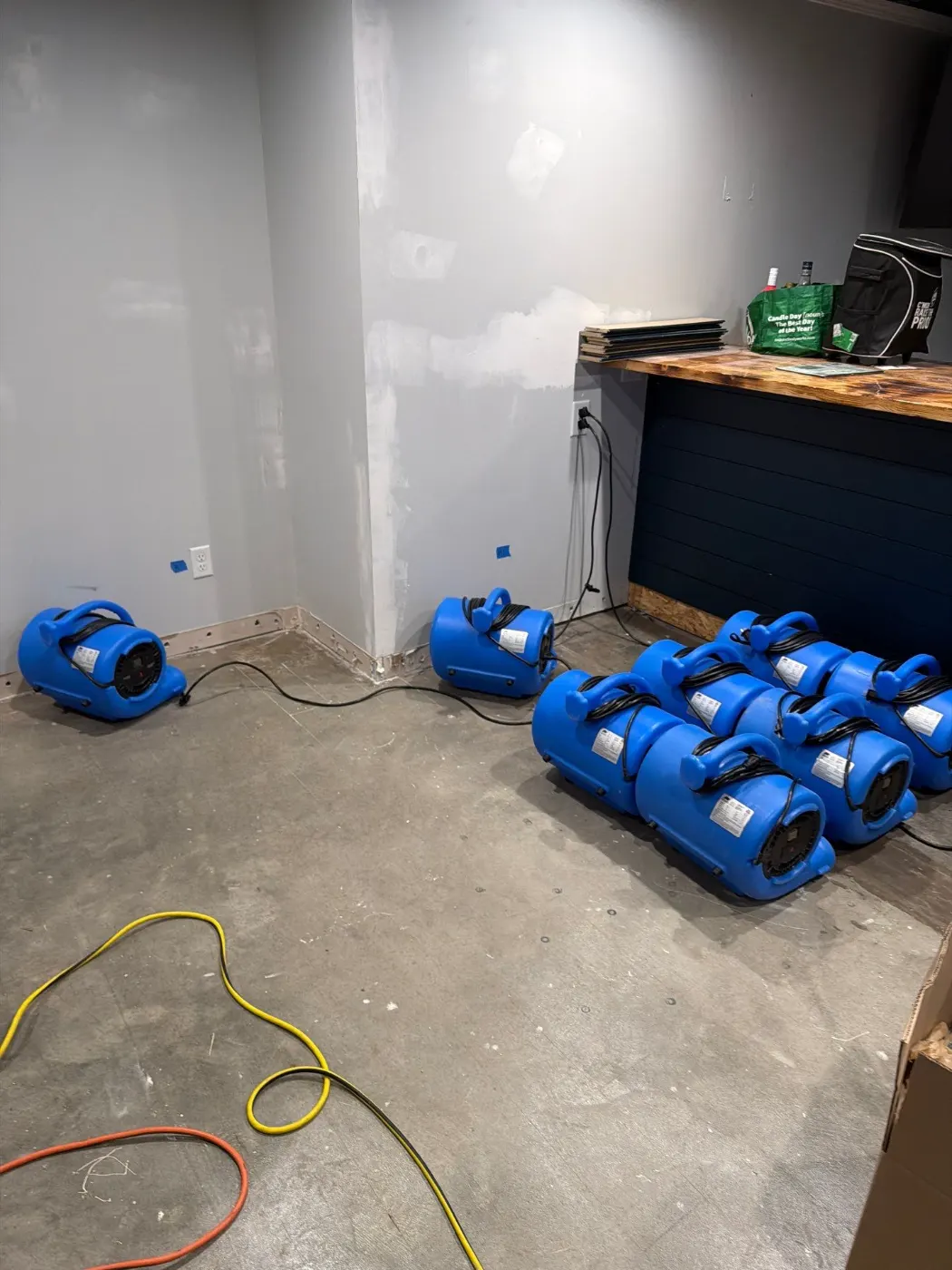
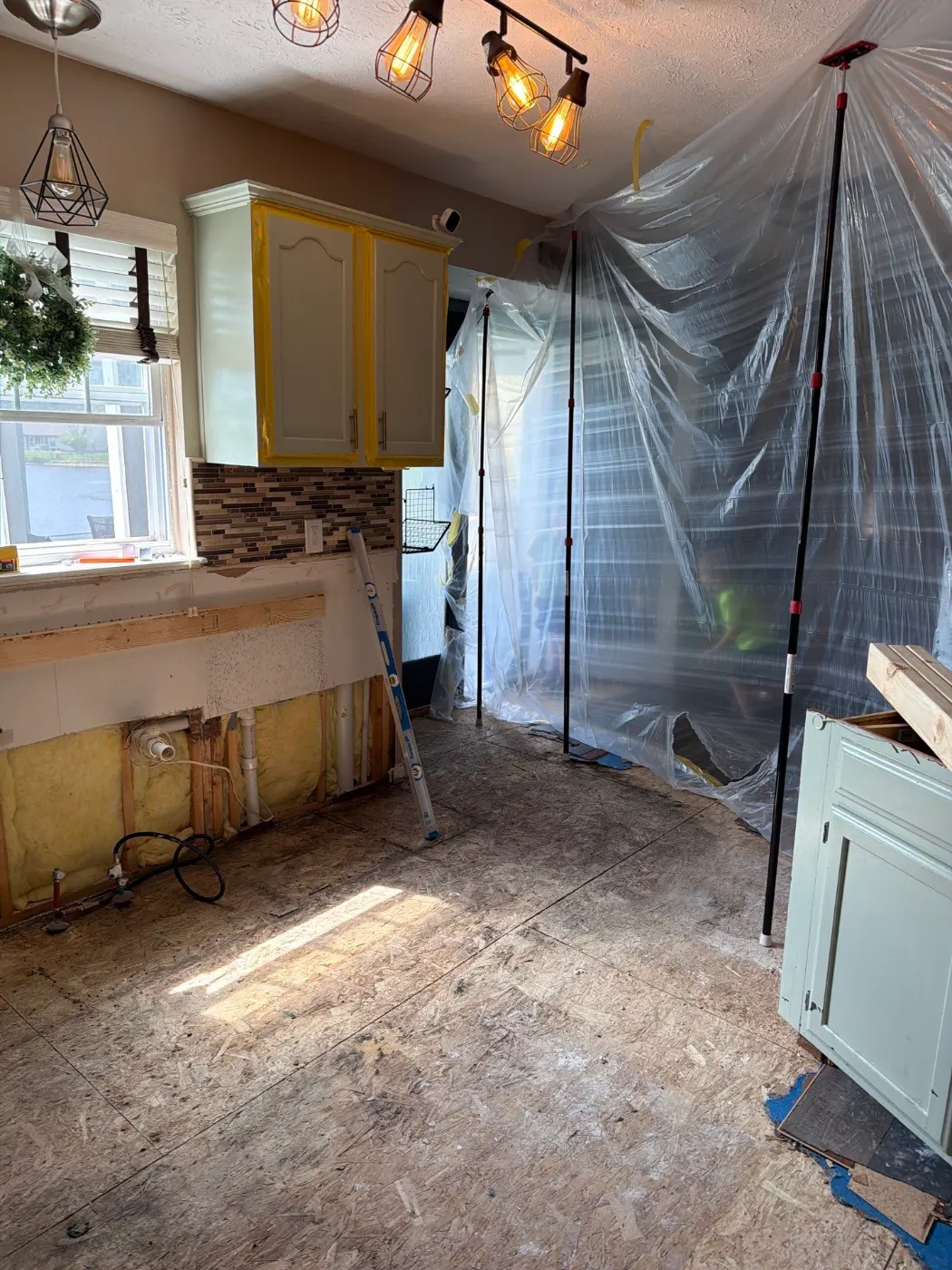
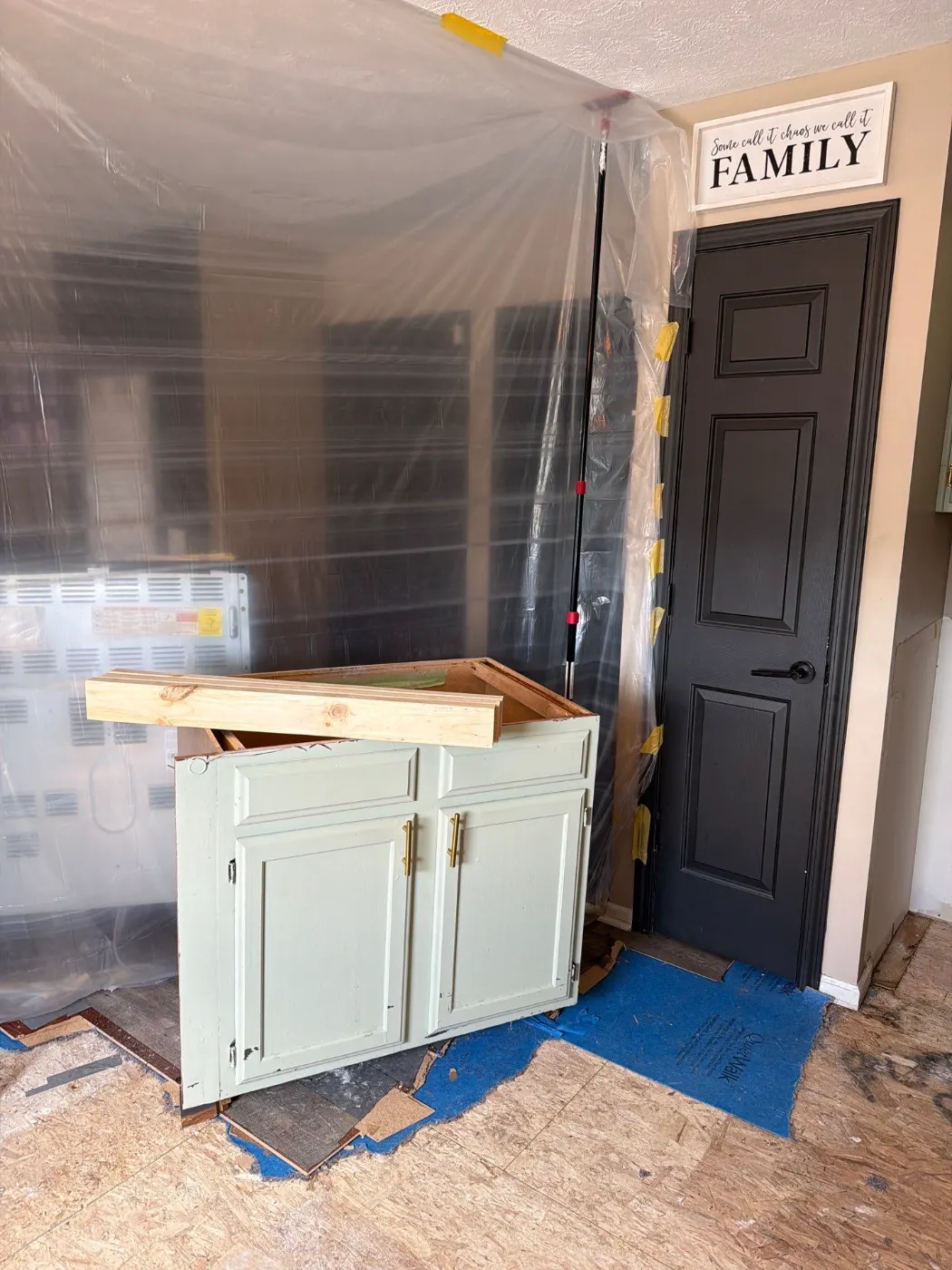
Recent water damage restoration projects across New Whiteland and the wider Johnson County service area, including basement floods, burst pipe repairs, sewage cleanups, and full reconstruction after storm intrusion.
The Process Behind Every New Whiteland Restoration
The first phase is moisture assessment and Category determination. When we arrive at your New Whiteland home, a certified tech walks the loss with thermal imaging and moisture meters, identifies the source, broken supply line, dishwasher failure, sewer backup, or storm intrusion, and classifies the water as Category 1, 2, or 3 per IICRC S500. The full scope of affected materials is mapped and documented before a single piece of drying equipment goes down. This phase typically takes one to two hours, and it determines everything that follows: equipment count, containment level, demolition scope, and the conversation we have with your adjuster.
Next is insurance coordination and documentation. Before mitigation starts, we photograph and video every affected area, log meter readings on a written moisture map, and open direct communication with your insurance adjuster. Scope of work is matched to your coverage, and the mitigation steps we take are justified in writing per the S500 standard. Most New Whiteland homeowners never see this paperwork, we handle it directly with the carrier so you are not chasing forms during the worst week of your year. If a coverage question comes up, we flag it for you before the work proceeds.
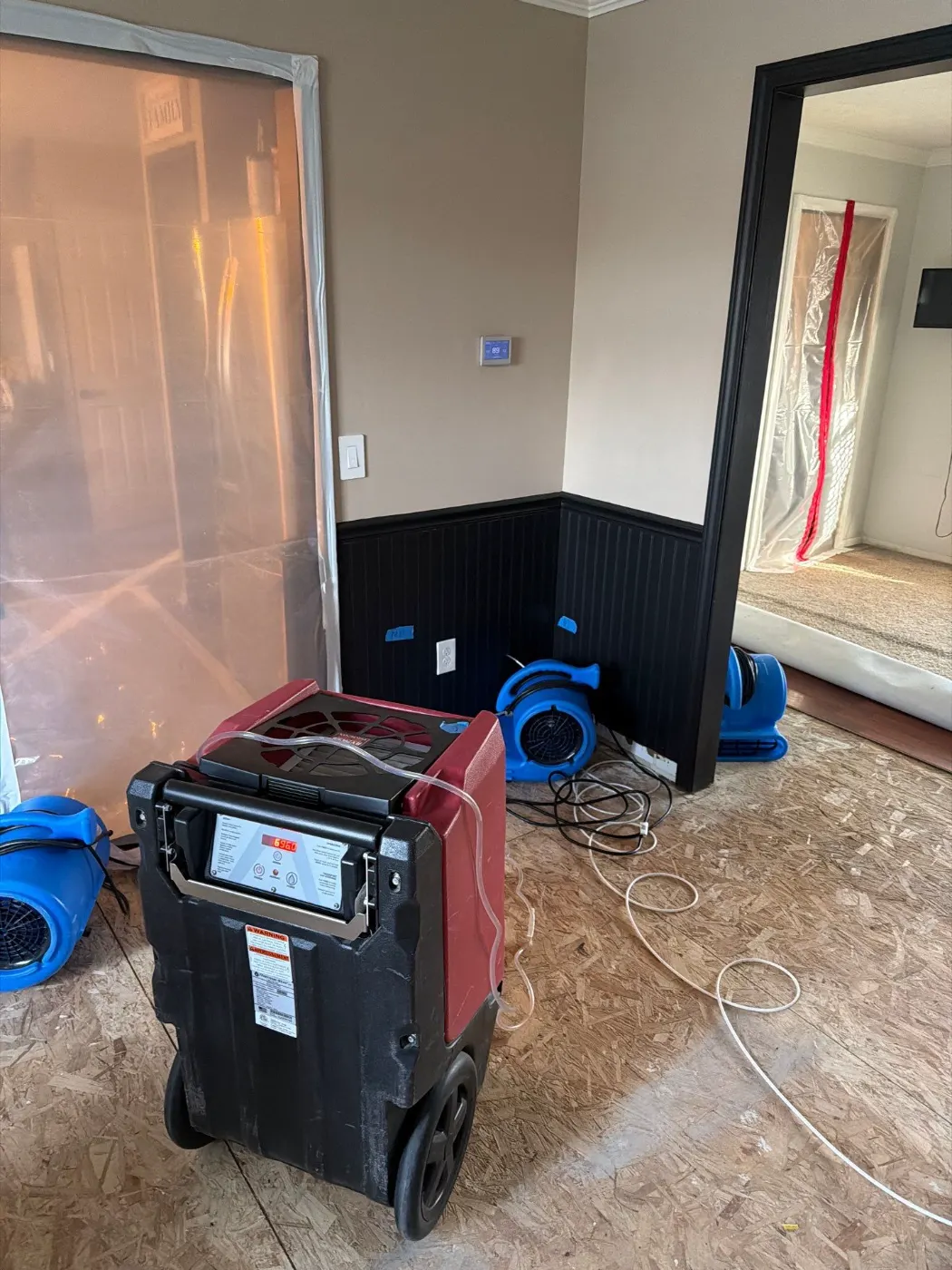
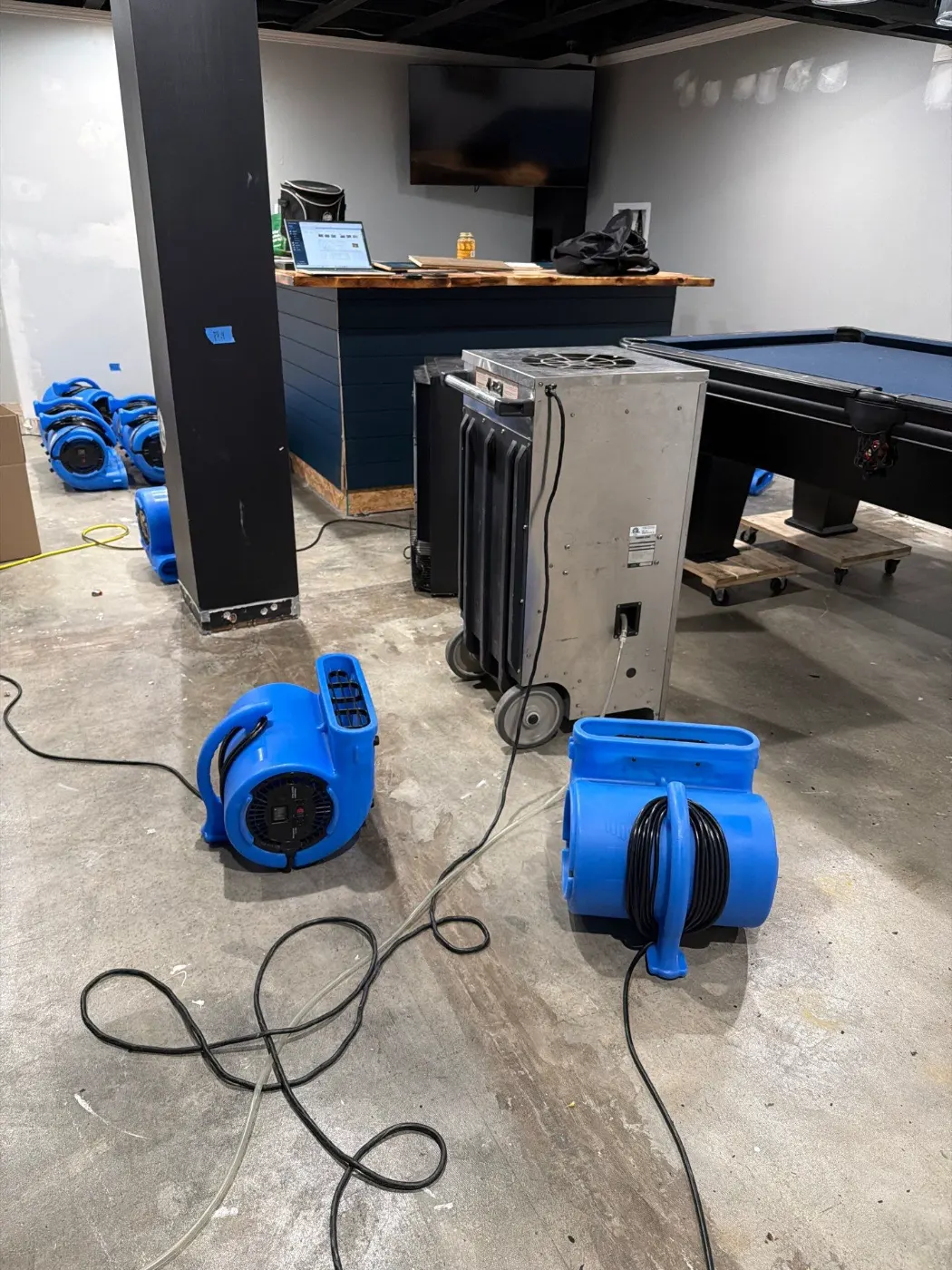
The third phase is drying execution and controlled reconstruction. Air movers and dehumidifiers are placed based on the affected square footage and the structural drying calculations our technicians work from, then monitored daily with logged readings until materials hit dry standard against unaffected sections of your home. Demolition is controlled and limited to what cannot be dried in place. Once dry verification is signed off, reconstruction begins: drywall, insulation, flooring, paint, and trim, finished to match what was there before the loss in your New Whiteland home.
Rapid Dispatch
Call comes in, certified tech leads a crew to your address, truck loaded with extraction equipment, dehumidifiers, and air movers. No second trip to fetch gear. Extraction begins on arrival so water stops migrating into subfloors and wall cavities.
Category Determination
Every loss in New Whiteland gets classified per IICRC S500: Category 1 clean water, Category 2 gray, or Category 3 black. Meter readings are logged, the source documented, and a written assessment becomes the foundation for the drying plan and the insurance scope.
Insurance Partnership
We work with your insurance carrier, not against them. Scope is justified, photos and moisture maps submitted, and the mitigation steps documented per industry standard. You see transparent invoicing.
Dry to Verified Standard
Drying continues until moisture content in affected materials matches unaffected baselines, confirmed with meters, not guesswork. Daily monitoring keeps the plan honest. Only then do we sign off and move into reconstruction.
How Water Gets Into New Whiteland Homes
Ice Dam Meltwater in the Wall
Wall cavities wet by ice dam water hold that moisture behind finished surfaces where nothing evaporates. We map the wet area, open only what has to open, and dry the cavity to standard rather than hoping the wall handles it on its own.
Sink Drain and P-Trap Leaks
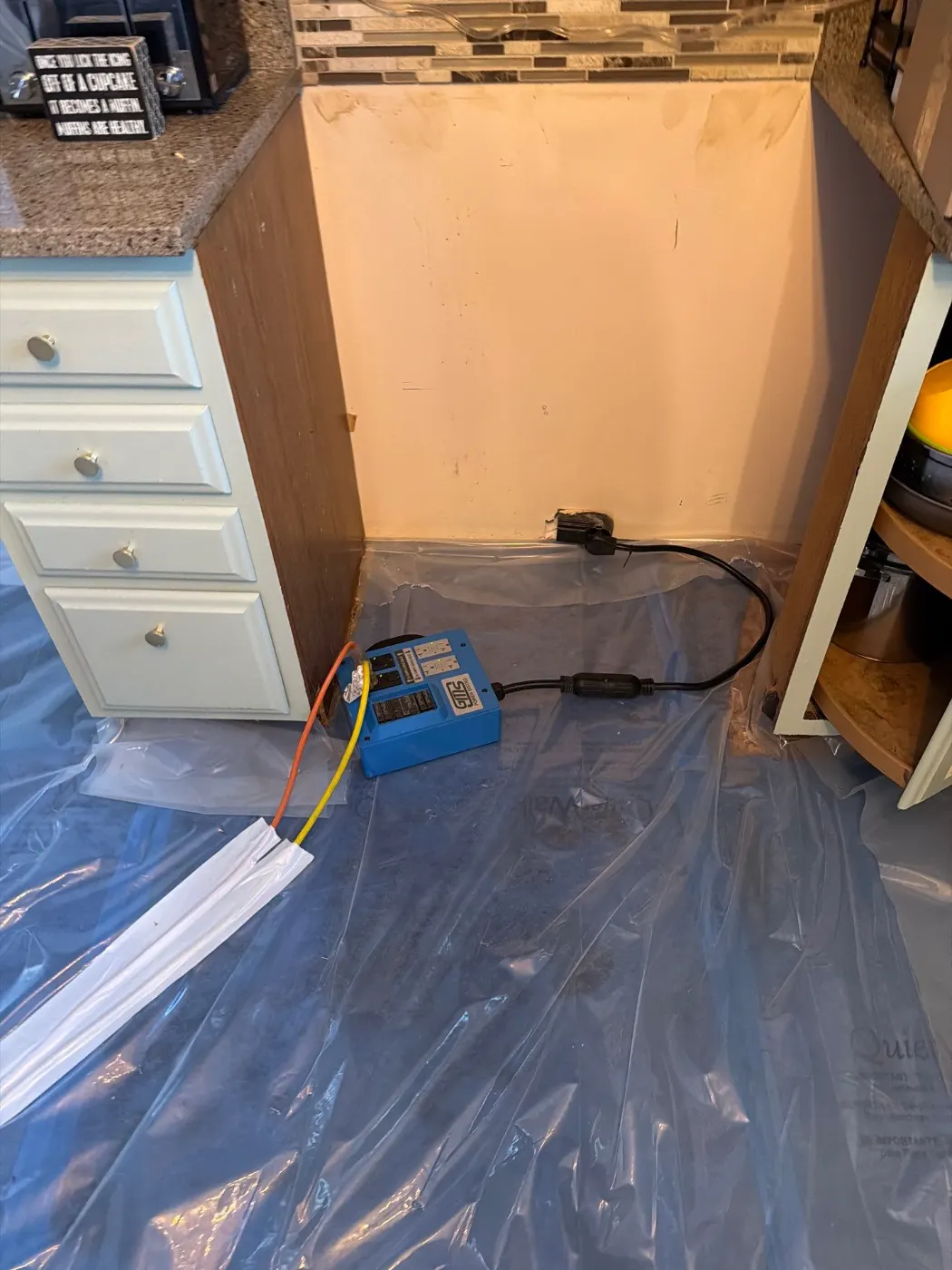
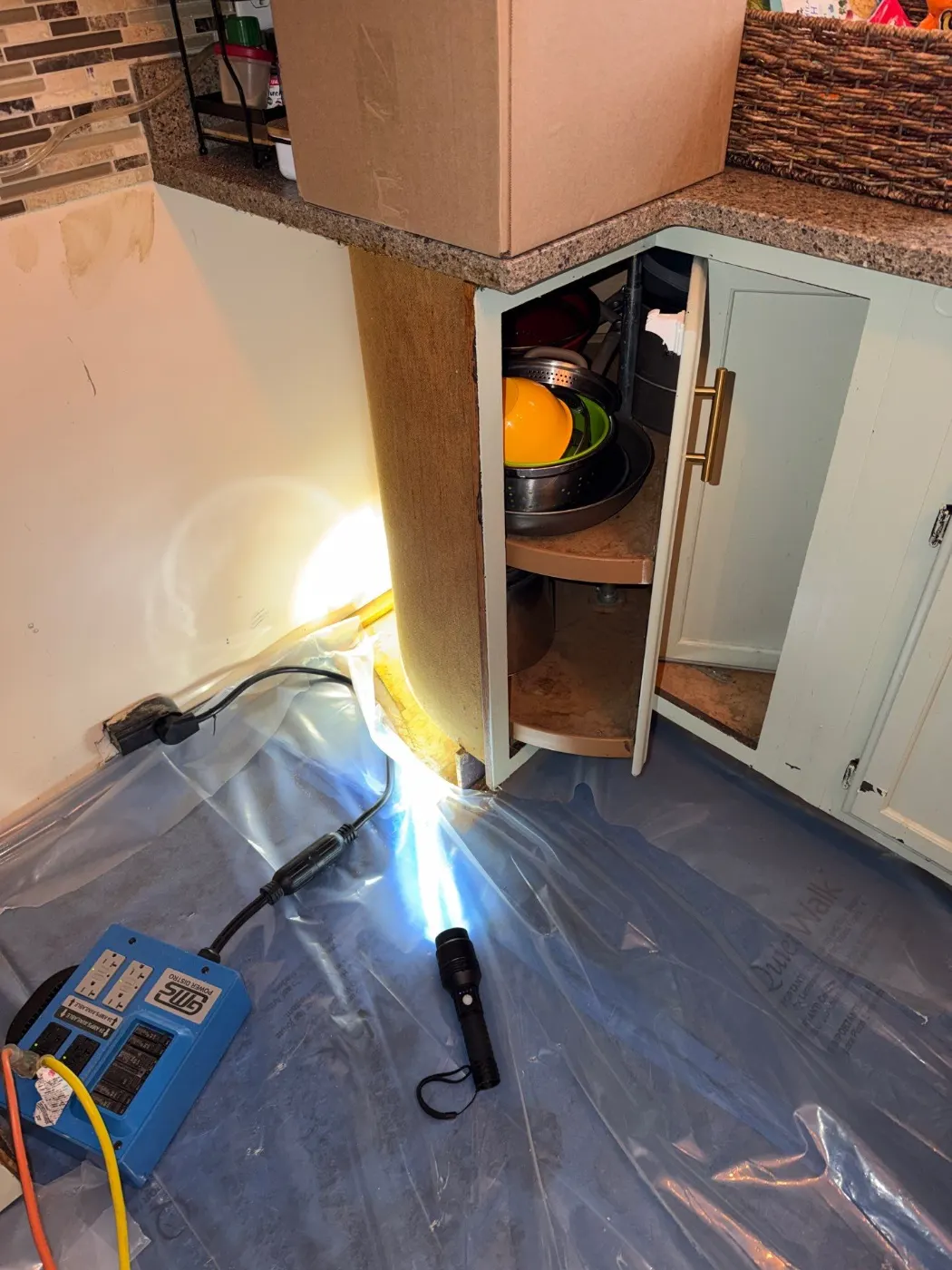
People catch trap leaks late because the water lands in a cabinet nobody empties. By the time the bottom panel bows, the subfloor under it has been through several wet cycles. In New Whiteland kitchens that usually pulls in the toe kick and the next cabinet over.
Frozen Pipe in an Exterior Wall
Nothing leaks while the pipe is frozen. The damage arrives with the thaw, often the next afternoon, when the ice releases and the split opens into the cavity. A New Whiteland homeowner who loses water to one fixture in January should treat that as urgent, not as an inconvenience.
Toilet Wax Ring and Flange Failure
Water leaving a failed wax ring has been through the bowl, so it is not clean. IICRC S500 puts it in Category 2 or 3 depending on what was in the trap and how long it has been sitting, and that drives what comes out rather than what gets dried.
Refrigerator Ice Maker Line
When a line fails while the family is away, the ice maker keeps calling for water and the line keeps delivering it. That is how a small tube produces a whole floor loss. Closing the shutoff before a trip takes about a minute.
Downspouts Discharging at the Foundation
A roof collects an enormous amount of water and the downspouts decide where it lands. End one at the wall and the entire load goes into the soil against the foundation, which is exactly the wrong place for it during a wet week.
Found Water in Your New Whiteland Home? What to Do First
In the first hour, close the main water valve if a pipe or appliance is leaking, and keep away from outlets and cords near the water. Then use the rest of this checklist to protect what you can while help is on the way.
1. Close the main valve first
Find the main shutoff and close it all the way. A round handle turns clockwise, and a lever handle turns so it sits across the pipe. If the valve won't move, your water utility can usually shut off service at the meter.
2. Watch the ceiling
If water is coming through a ceiling, keep people out of the room below. A ceiling that sags or bulges can hold a lot of water, and the light fixtures in it may be wet, so turn those circuits off at the panel if you can do it safely.
3. Protect yourself first
If you have to step into wet areas, wear rubber boots and gloves. Take the basement stairs slowly if they're wet, and leave the cleanup of any dirty water to the crew.
4. Save the paperwork
Deeds and family records are hard to replace, so move them to a dry room before anything else. Put them in a plastic bin or a sealed bag if the rest of the house is damp.
5. Lift furniture off wet carpet
Slide aluminum foil or plastic lids under the legs of wood furniture so stains don't bleed into the carpet. Pull up throw rugs and hang them somewhere dry, since they hold water against the floor underneath.
6. Leave the record to us
You have enough to deal with in the first hour. Our crew documents the damage with photos and moisture readings as soon as we arrive, and we walk you through what we found once the work is underway.
7. Use the right tools for small spills
Towels and a mop handle a small amount of clean water. For more than that, use a shop vac rated for wet pickup, and keep regular household vacuums away from the water.
8. Make the call early
Waiting until morning gives the water all night to soak into floors and walls. Our line is open 24/7, so call once the water is shut off and everyone is safe.
If you only get through the first two steps before help arrives, that's fine, since the water source and your safety come first. Call us when you're ready and we'll take it from there.
Three Simple Steps
The steps below are the same on every job, and the crew explains each one before it starts.
The Emergency Line
Time is the only thing that cannot be added back to a water loss. The truck carries what a Category 3 call needs, on every call. Emergency intake takes minutes, and a crew is dispatched within 2 hours.
Inspection & Evidence
Every reading is logged with location, material, and moisture content. No plan gets built on assumptions.
Drying and Restoration
A New Whiteland dry out runs about 3 to 5 days, and the log proves when it is done. Done means demonstrated.
What the Photo Report Shows New Whiteland Homeowners
The photo report lets you see the damage for yourself, room by room, with the crew's photos and the readings behind every recommendation we make in your New Whiteland home. It starts on the first visit and grows as the drying goes.
Where the water came from
The report starts at the source. If a supply line failed or a drain backed up, the crew photographs the part that failed and where it sits, so you know exactly what needs fixing before the water can come back.
Water you can't see
Water often ends up somewhere out of sight, like under cabinets or inside a wall cavity. The report shows those spots with readings and photos so nothing gets closed back up while it's still wet.
Pictures from start to finish
Photos go into the report at each stage of the job, starting with the damage the crew found when they first walked in. By the end, you have a visual history of the room from wet to dry.
What can dry where it is
Some materials can be dried right where they are, and some have to come out. The report shows which is which, with the readings behind each call, so you understand why a section of drywall or flooring is being removed.
Updates as the work goes
Drying takes several days in most homes, and the report grows the whole time. New readings and photos get added on each visit, so you always know where things stand in each room.
Questions are welcome
Ask about anything in the report that doesn't add up. The crew can take a new reading while you watch and explain what it means for that room, and seeing a dry wall next to a wet one makes the numbers easier to follow.
A record that's yours
Keep the report with your home records. We document damage with a photo report and walk you through what we found, so you can decide with your insurance company. Your policy will say what's covered, so read it before you call them.
Ask for your photo report at any point during the job, and we'll go over the latest readings with you.
Questions to Ask a Water Damage Company in New Whiteland
Ask any restoration company in New Whiteland these questions before you sign a work authorization.
Can I see an itemized estimate?
Ask for every line item in writing. Many insurers price water losses in Xactimate, so an estimate in that format is easier for an adjuster to review.
Does my policy require a certain company?
Ask your adjuster before you sign anything, and read the work authorization so you know what you're agreeing to.
What happens if you find mold?
Ask how mold behind walls or under floors gets handled, and whether that work is priced apart from the drying.
Who handles repairs after drying?
Ask who replaces drywall, flooring, paint and trim once the structure is dry, and whether one company can do both stages.
Who will be working in my home?
Ask whether the crew works for the company you called or for a subcontractor, and who's in charge on site each day.
How will you show me it's dry?
Ask for moisture readings on the first visit and the last one, so you can see the numbers reach dry standard.
Indiana Weather Drives Restoration Calls Year Round
Indiana weather keeps our New Whiteland phone line busy in distinct seasonal waves: hard winter freezes that burst aging supply lines in January, spring thunderstorm cells dropping multiple inches in a day onto already saturated ground, and humid summer stretches that grow mold in any space that did not get dried correctly the first time.
Winter Pipe Bursts
Indiana cold snaps are brutal on aging supply lines, and New Whiteland holds the state record for cold at 36 below. When a galvanized or copper line freezes and splits at 2 AM, gallons hit the floor before anyone wakes up. We extract, dry the cavity, and rebuild the affected rooms.
Spring Saturation Flooding
Flat Pleasant Township terrain and heavy spring rains push groundwater hard against foundation walls and slab joints. Basements and crawl spaces take on water through cracks, window wells, and floor drains. Our crews pump, extract, dehumidify, and treat for microbial growth before finishes go back in.
Severe Thunderstorm Intrusion
South central Indiana storm cells routinely drop two to three inches in a day, and wind driven rain finds every weakness in a New Whiteland home. When water comes in through compromised exterior openings, we contain the spread, dry the structure, and document the loss for your storm damage claim.
Sewer Backup Surcharges
Heavy rain can surcharge older municipal lines and push waste back through floor drains and basement fixtures across New Whiteland. Category 3 water requires containment, controlled demolition of porous materials, and antimicrobial treatment per IICRC S520, not a mop and a fan.
Homes We Cover Around New Whiteland
Homes in different parts of New Whiteland were built at different times, so open a neighborhood for the details that apply there.
Where we respond near New Whiteland
Our 24/7 dispatch covers New Whiteland and the communities right around it.
Restoration Considerations Specific to New Whiteland
What our crew looks for in New Whiteland homes.
About New Whiteland Homes
New Whiteland was incorporated in 1954 and the median construction year for its housing stock is 1974, meaning the dominant build era spans the 1950s through the 1980s, with a second wave of new construction arriving in the 2000s,2020s. Homes built in that core 1954,1985 window would predominantly carry galvanized steel or early copper supply plumbing, while post-1990s additions and newer subdivisions shifted to copper and PEX. The housing stock is overwhelmingly detached single family homes (98.6% of units), with ranch style homes from the 1960s,1970s being the most common older type alongside a growing inventory of two story suburban homes built in the 2000s and later; the flat Johnson County terrain and tract home construction of the postwar era means full or partial basements are common in the older stock, with slab on grade more typical in newer subdivisions. The town also contains Tracy Commons, a maintenance free subdivision of condominiums and townhouses.
Where We Work in New Whiteland
We cover homeowners across New Whiteland near Proctor Park, East Park, Country Gate Park, Break-O-Day Elementary School (900 Sawmill Rd), Whiteland Community High School, Whiteland Raceway Park, Kacey's Pizza Spot, US Highway 31 corridor.
Surrounding Areas We Serve
Our crew also covers Whiteland, Greenwood, Bargersville, Franklin, Edinburgh, Needham.
Recent Weather Patterns
Johnson County, Indiana has a documented history of tornadoes, severe thunderstorms, and flash flooding; a powerful storm system in April 2026 dropped over three inches of rain in 24 hours across south central Indiana, causing widespread areal flooding, streams overflowing into roads, and wet basements throughout the county. The region also carries extreme freeze thaw exposure,New Whiteland recorded the coldest temperature ever documented in Indiana (-36°F on January 19, 1994),making burst pipe events from hard freezes a recurring residential water damage risk.
What Our Crew Sees in New Whiteland
New Whiteland's housing stock, with a median construction year of 1974 and a large cohort of homes built between the 1950s and 1980s, presents elevated plumbing failure risk from aging galvanized and early copper supply lines that are now decades past expected service life. The flat Pleasant Township terrain and proximity to Grassy Creek (which bisects the western edge of town per town ordinance boundary descriptions) create standing water and surface drainage risk during heavy rainfall events, making basement intrusion and crawl space saturation common complaints in older ranch style homes. The town's wastewater treatment plant (401 Moorland Dr) serves a municipal sewer system installed largely in the 1950s,1970s, meaning aging clay tile or cast iron lateral lines in the older residential core are susceptible to root intrusion, joint failure, and sewer backup events during heavy rain surcharges.
The New Whiteland Area
New Whiteland has a population of approximately 5,550,5,864 residents with a median household income of roughly $89,000,$93,000, well above the national median, and a homeownership rate near 83,90%. The community skews young (median age ~33,35 years) and is dominated by owner occupied, family households, with 74.5% of households classified as families.
What a Water Loss in New Whiteland Involves
The three phases of a water loss, and what each one involves.
Emergency response is the first truck on the ground at your New Whiteland home, and it shows up loaded for the job. Commercial water extraction equipment for the standing water, commercial dehumidifiers sized to the affected square footage, professional air movers for surface drying, moisture meters for verification, and thermal imaging to find moisture behind finished surfaces. Extraction begins promptly on arrival, and structural drying setup happens the same day so materials are not sitting wet overnight. We protect unaffected areas with plastic, contain the work zone, and walk you through what each piece of equipment does and why it is where it is. Daily monitoring with logged readings keeps the drying plan honest, and you get a clear picture of what to expect day by day. This is the standard playbook for Category 1 and Category 2 losses across New Whiteland.
Specialized containment is the phase where IICRC certification stops being a marketing line and starts being the difference between a clean restoration and a lingering health problem. It applies when we are dealing with Category 3 water, sewage backup, floodwater, long stagnant standing water, or full mold remediation under the IICRC S520 standard. We build 6-mil plastic barriers floor to ceiling, seal entry points, and run negative air machines that pull contained air through HEPA filtration before exhausting. Technicians work in full PPE: Tyvek suits, N95 or P100 respirators per S520, nitrile gloves, eye protection. Contaminated porous materials are cut out and bagged for disposal, antimicrobial is applied to remaining structure, and post remediation verification with air sampling is performed when the situation warrants it. Corner cutting in this phase is what causes the call six months later.
Reconstruction is where most restoration companies hand you off to a separate general contractor and disappear. We do not work that way. The same crew that performed extraction and drying handles the rebuild: drywall hung, taped, mudded, sanded, primed, and painted; flooring replaced, carpet pad, vinyl plank, hardwood refinish, or tile reset; trim and baseboards reinstalled or replaced; cabinetry repaired or replaced; doors rehung; finish electrical coordinated with your licensed electrician. You have one project manager to call, one schedule on the wall, and one final invoice when the work is done. The alternative, two crews, two schedules, two billing cycles, and a house sitting in demolition between phases, is exactly what we built our process to avoid for New Whiteland homeowners.
What Happens During the Days Your New Whiteland Home Is Drying
Drying is the longest part of a water job, and it happens while you're living in the house. The notes below cover what the equipment does and what the crew needs from you while it runs.
Expect steady noise
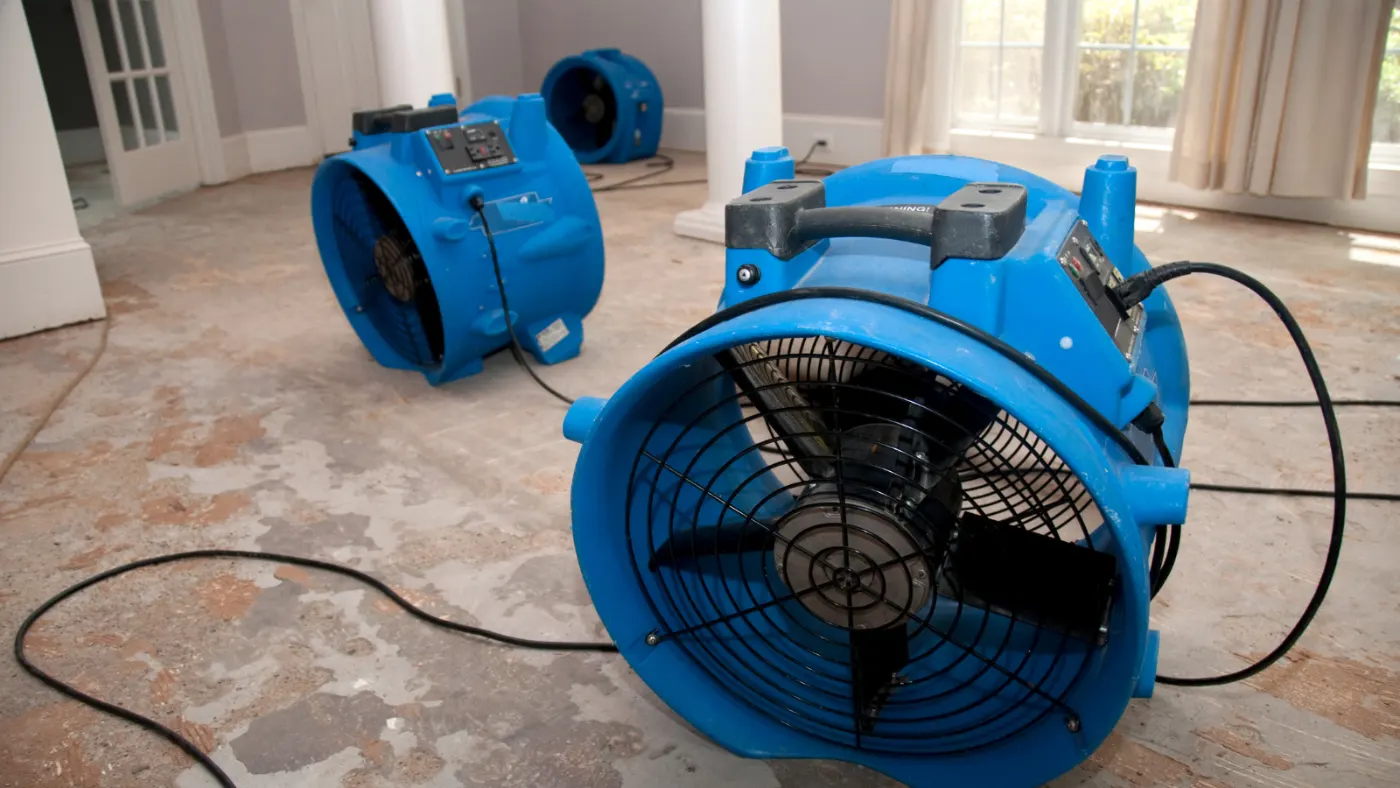
Air movers sound like strong box fans, and dehumidifiers add a low hum. A closed door between a bedroom and the equipment helps at night, and the crew can sometimes angle a unit away from a bedroom wall if the noise carries.
Keep everything plugged in
Turning the equipment off slows the drying and can add days to the job. If the noise is a problem at night, call us and the crew will look at the setup with you on their next visit.
Keep the room set up the same way
The crew will tell you which doors to keep closed and where to set the thermostat. Drying works by controlling the air in the room, so keeping it the way it was set up keeps the drying on schedule.
Keep cords clear
Cords run along the floor between the outlets and the equipment. Leave them where the crew routed them, and keep rugs and furniture off the cords so they stay cool and easy to see.
Safe paths through the house
Equipment and cords can turn a familiar hallway into a tripping spot, especially at night. Leave a light on along the path you use most, and keep small kids away from the units while they run.
A crew visit each day
Someone from the crew stops by each day to take readings and move the equipment where it's needed. Tell them about anything new you notice, like a musty smell or a soft spot in the floor.
Humidity after the job
CDC recommends keeping indoor humidity as low as you can, no higher than 50 percent all day long. After the equipment leaves, a basement dehumidifier and a working bathroom fan help keep it there.
The last day of drying
On the final visit, the crew takes one more set of readings to confirm the wet areas are dry. Then the equipment comes out and the rooms are ready for any repairs they need.
Call us if anything changes while the equipment runs, like a new stain or a unit that shuts off on its own.
Sources: CDC, About Mold
Water damage pricing in New Whiteland
Mitigation ranges calibrated to the New Whiteland market. Final pricing depends on water volume, materials affected, and IICRC Category.
FAQ · New Whiteland Water Damage
Read through these, then call us with anything they leave open about your New Whiteland home.
Expert New Whiteland Restoration Crews Available Now
If water is spreading through your New Whiteland home right now, or you suspect hidden moisture from a recent storm or appliance failure, call for fast emergency dispatch. Free on site inspection, no obligation, and we work directly with your insurance carrier from documentation through final reconstruction.